

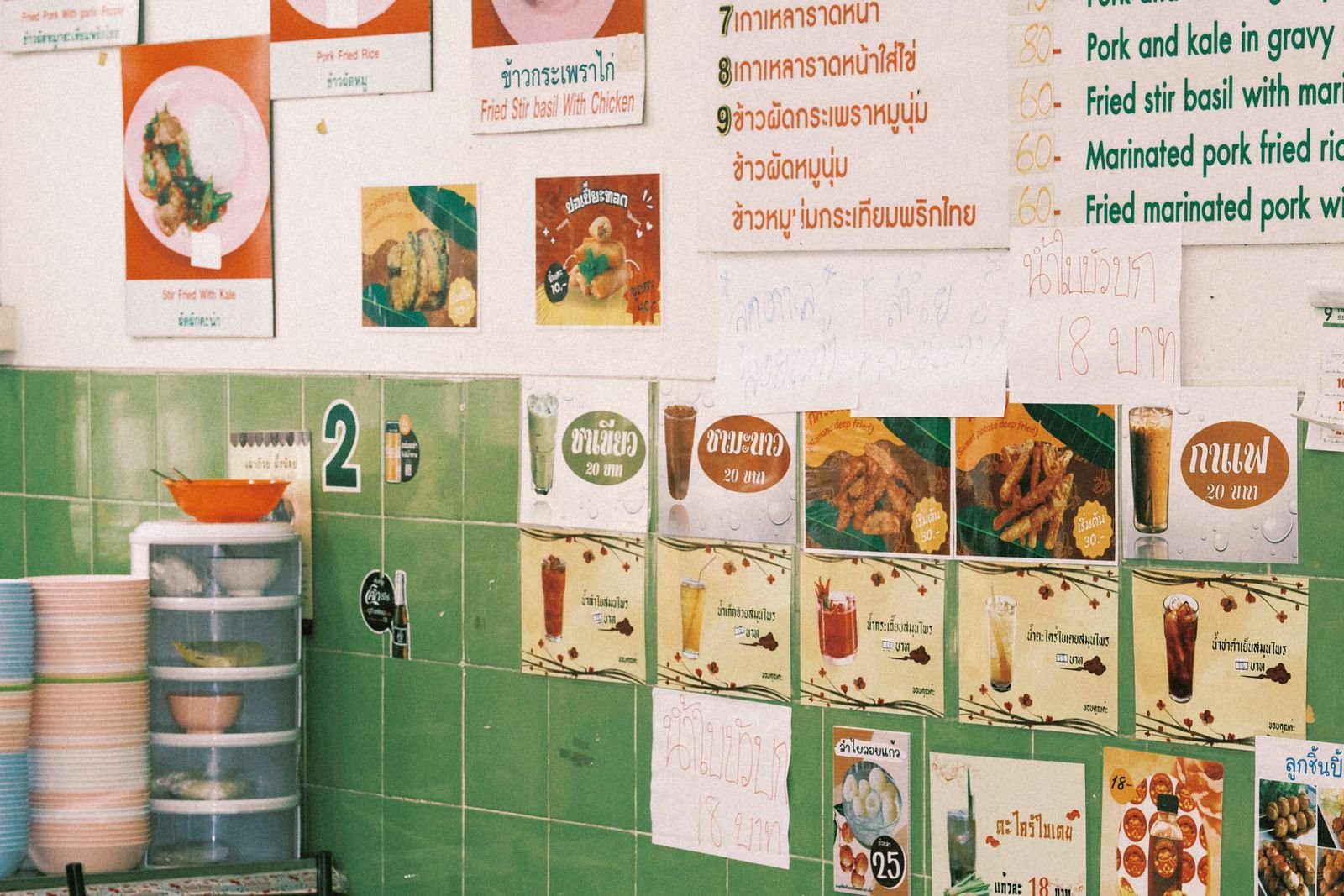
Cost each dish to the gram, choose a target food cost percentage for it, and divide: menu price = portion cost ÷ target food cost %. A dish costing 85 at a 30% target needs a price of at least 283, so 290 on the menu. Then check the price against the market and what the dish earns in cash.
By Michael Clarke, trained chef and restaurant marketer. Last updated 14 November 2026.
Quick answer
- Price from the real cost of one portion, not from what the place next door charges.
- Formula: menu price = portion cost ÷ target food cost % (as a decimal).
- Targets can differ by dish; what matters is the overall mix.
- Check gross profit in money, not just percentage: a high-cost steak can still earn more per plate.
- Re-cost and review prices whenever supplier prices move.
I run Markedine, a restaurant marketing company in Bangkok. The free Google audit at the end of this article is a Markedine offer. This article does not contain affiliate links.
How do you price a menu item, step by step?
- Write the recipe for one portion. Every ingredient by weight or volume, including garnish, sauce, oil and bread on the side.
- Cost it at today’s supplier prices, using the usable yield after trimming, not the purchase weight.
- Choose a target food cost percentage for the dish, based on your concept and your overall target.
- Divide the portion cost by the target to get the minimum price. 85 ÷ 0.30 = 283.
- Round to a sensible menu price, such as 290.
- Check it against the market and against what guests expect to pay for that dish in your area.
- Look at gross profit per portion (price minus cost) and decide whether the dish earns its place on the menu.
Menu price calculator
Enter the portion cost and your target. Add tax and service charge only if they are added on top of menu prices on the bill.
Menu price calculator
Works in any currency. Nothing you type leaves your browser.
How do you work out the cost of one portion?
This is where most menus go wrong. Owners cost the main protein and guess the rest. The small things add up: a spoon of chilli oil, a lime wedge, the rice, the side salad, the takeaway box.
Use yield. If you buy a whole fish and can only serve 55% of its weight, your cost per usable gram is almost double the price on the invoice. Weigh it once, write the yield on the recipe card, and use it every time you cost the dish.
When I trained as a chef, recipe cards were about consistency. In management I learned they are just as much about money. If the card says 150 grams and the cook plates 190 on a busy night, your food cost moves and your price is wrong.
What target food cost should you use?
There is no universal correct target, so I will not give you one. Set it from your own numbers: what is left after food cost has to pay labour, rent, utilities and everything else and still leave profit. Our Markedine consulting work includes menu pricing by segment and food cost planning for exactly this reason: the target belongs to the business plan, not to a rule of thumb.
Targets can also differ by dish. A rice or noodle dish can run a lower food cost than a premium seafood plate. That is fine, as long as the overall mix lands where your P&L needs it. See how to calculate food cost percentage to check what actually happens.
Why is gross profit per dish as important as food cost percentage?
Percentage can mislead. Compare two dishes:
| Dish | Cost | Price | Food cost % | Gross profit per portion |
|---|---|---|---|---|
| Pad kra pao | 40 | 160 | 25% | 120 |
| Grilled river prawns | 300 | 750 | 40% | 450 |
These are made-up numbers for illustration. The prawns look worse on percentage but earn more than three times the cash per plate. If they sell, they may be your most valuable dish. Look at both numbers before you cut anything.
How do you use menu engineering to find the problem dishes?
Take one month of item sales from your POS and put every dish into one of four groups:
| Group | Sells | Profit per portion | What to do |
|---|---|---|---|
| Stars | Well | High | Keep, protect quality, feature them |
| Workhorses | Well | Low | Re-cost, adjust portion or price carefully |
| Puzzles | Poorly | High | Better description, photo, position, or staff recommendation |
| Dogs | Poorly | Low | Remove or rework |
Design matters too. We worked with a French cafe on Sukhumvit whose owner said the work helped them focus on upsell artwork and higher-margin products. Table talkers, menu layout and photos steer what guests order, and that changes your average margin without changing a single price.
How should prices look on the menu itself?
Once the numbers work, presentation matters. A few habits that keep a menu honest and easy to read:
- Round to clean numbers that fit your concept. A neighbourhood restaurant and a fine-dining room will round differently.
- Do not line prices up in a column down the right-hand edge. It invites guests to scan for the cheapest dish instead of reading the descriptions.
- Describe what makes a dish worth its price: the cut, the origin, the cooking method. A higher price needs a reason.
- Show clearly whether tax and service charge are added on top, so the bill does not surprise anyone.
- Keep the delivery-app menu consistent with the dine-in menu, so a guest never feels caught out.
How often should you review menu prices?
- When a key supplier price changes, re-cost the dishes that use it straight away.
- Every quarter, re-cost the full menu and review the menu engineering groups.
- When you reprint the menu, adjust prices then, and change a few at a time rather than all at once.
- Check delivery-app prices separately, because commissions change the maths. See GrabFood vs LINE MAN.
Frequently asked questions
What is the formula for menu pricing?
Menu price equals the cost of one portion divided by your target food cost percentage expressed as a decimal. For example, 85 divided by 0.30 is about 283, which you might round to 290.
What is a good food cost percentage for menu pricing?
There is no single correct number. Set your target from your own P&L so that what remains after food cost covers labour, rent and other costs and leaves a profit. Targets can differ by dish.
Should I price my menu like my competitors?
Use competitor prices as a check, not a starting point. Start from your own costs, then make sure the price makes sense in your market.
Should menu prices include VAT and service charge?
That depends on how you present prices and local rules. The calculator lets you add tax and service charge on top if your menu prices exclude them.
How often should I change menu prices?
Re-cost dishes when supplier prices change, review the whole menu every quarter, and change prices when you reprint the menu.
Sources
Free Google audit
I run Markedine, and the free Google audit on this site is a Markedine offer. We look at your live Google profile, Maps presence and reviews, and send back practical fixes. There is no obligation to hire us. If your restaurant is in Thailand or Southeast Asia, the request goes to the Markedine team.